
TiO2-Free Empty Capsules: A Bulk Buyer’s Guide to Titanium Dioxide-Free Gelatin & HPMC Shells
Titanium dioxide (E171) is banned in EU supplements and under FDA review in the US. Here's what TiO2-free empty capsules are, how clear and coloured options compare, and what to ask your supplier before buying in bulk.
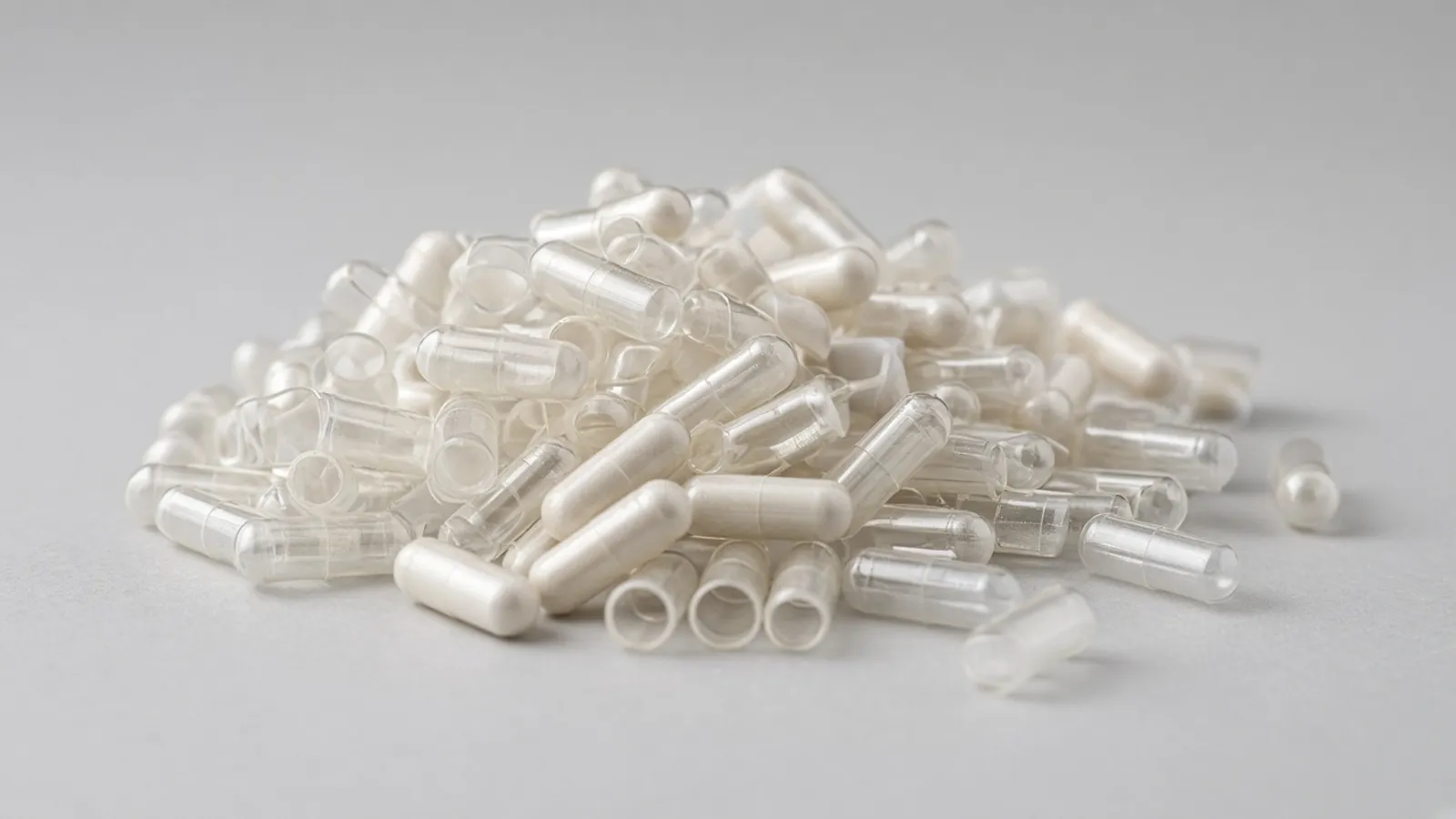
TiO2-free empty capsules are hard capsule shells (gelatin or HPMC) made without titanium dioxide (E171), the white pigment traditionally used to make capsules opaque. The EU banned E171 as a food additive in 2022, which covers food supplements, while in the US the FDA still permits titanium dioxide but is reviewing a 2023 petition to revoke its use in food. For supplement brands selling into the EU, or answering “clean label” demand in the US, clear or alternatively coloured TiO2-free shells are now the safest default specification.
Sourcing titanium-dioxide-free shells for your next production run? Request a bulk quote and tell us your size, material and colour. We will confirm TiO2-free availability, documentation and lead time in writing.
What does “TiO2-free” actually mean for an empty capsule?
A standard opaque white or coloured hard capsule usually gets its opacity from titanium dioxide dispersed in the shell film. A TiO2-free capsule simply leaves it out. That gives you three practical options:
- Clear (transparent) shells: no opacifier at all. These are inherently TiO2-free, and the fill is visible.
- Coloured shells without TiO2: colour comes from other permitted colourants, with no white pigment base. Shades often look more translucent or slightly different from the TiO2 version.
- Opaque “white” alternatives: shells that use a different opacifying system. Opacity and appearance vary by manufacturer, so always ask for physical samples.
The shell polymer doesn’t change. You can get TiO2-free versions of gelatin capsules and HPMC (hypromellose) capsules. If you are still choosing a base material, see our gelatin vs HPMC comparison for manufacturers.
Why did the EU ban titanium dioxide (E171)?
In May 2021 the European Food Safety Authority (EFSA) concluded that titanium dioxide “can no longer be considered safe as a food additive”. The key reason was that a concern for genotoxicity (the ability to damage DNA) could not be ruled out, so no Acceptable Daily Intake could be set (EFSA, 2021). EFSA also noted that E171 contains at most 50% of particles in the nano range (under 100 nm).
The European Commission then adopted Commission Regulation (EU) 2022/63, which removed E171 from the list of food additives authorised for use in foods. The regulation entered into force on 7 February 2022. Under Article 2, foods made under the old rules could still be placed on the market until 7 August 2022, and could then stay on sale until their best-before or use-by date (European Commission Q&A). The Commission lists food supplements among the foods that used E171, so supplement capsules placed on the EU market must now be TiO2-free.
Medicines are treated differently. To avoid shortages, the regulation kept E171 provisionally on the authorised list for use only as a colour in medicinal products, and required a review within three years. In April 2024 the European Medicines Agency (EMA) sent an updated analysis to the Commission. It found that the alternatives tested were inferior to TiO2 across the full set of criteria and that replacing TiO2 would risk significant medicine shortages. In its August 2025 staff working document, the Commission concluded that TiO2 use in medicinal products “should be maintained”, while urging industry to keep developing alternatives and to justify excipient choices for new medicines. In short: EU supplements must be TiO2-free, but EU medicines may still use TiO2 shells for now.
Is titanium dioxide banned in the US?
No, not at federal level. According to the FDA’s color additive status listing, titanium dioxide is “permanently listed, exempt from certification” for foods, drugs, cosmetics and devices. In foods it may not exceed 1% by weight (21 CFR 73.575). For drugs, 21 CFR 73.1575 permits titanium dioxide for colouring ingested and externally applied drugs generally, “in amounts consistent with good manufacturing practice”.
The regulatory direction is changing, though. A 2023 Color Additive Petition from consumer and environmental groups asks the FDA to revoke the listing for titanium dioxide in food. The FDA\'s petition tracker lists it as CAP 3C0325, “under review”. State legislatures are also proposing restrictions on food chemicals that include titanium dioxide (see the EWG state tracker). Many of these bills are proposals, not enacted law, so check the current status for the states you sell into.
Bottom line for US buyers: TiO2 capsules are legal today. But if you export to the EU, sell on clean-label positioning, or want to avoid reformulating later, specifying TiO2-free now is the low-risk choice.
Gelatin or HPMC: which TiO2-free capsule should you choose?
Both materials work without titanium dioxide. Your choice is driven by the same factors as any capsule decision:
| Factor | TiO2-free gelatin | TiO2-free HPMC |
|---|---|---|
| Source | Animal-derived (bovine/porcine) | Plant-derived cellulose |
| Dietary claims | Halal possible (Capsules Hub gelatin is Halal certified) | Suited to vegetarian/vegan positioning |
| Clear option | Yes, very high transparency | Yes, typically slightly hazier |
| Hygroscopic or moisture-sensitive fills | Gelatin’s higher water content can interact with the fill | Lower moisture content, often preferred |
| Typical buyer | Mainstream supplement and pharma lines | Vegan, clean-label and premium brands |
For delayed-release products, ask whether enteric coated capsules can be supplied in a TiO2-free version. See enteric coated capsules explained for how they work. For vegan specifics, read our HPMC vegan capsules buyer’s guide.
Clear vs opaque without TiO2: what changes in practice?
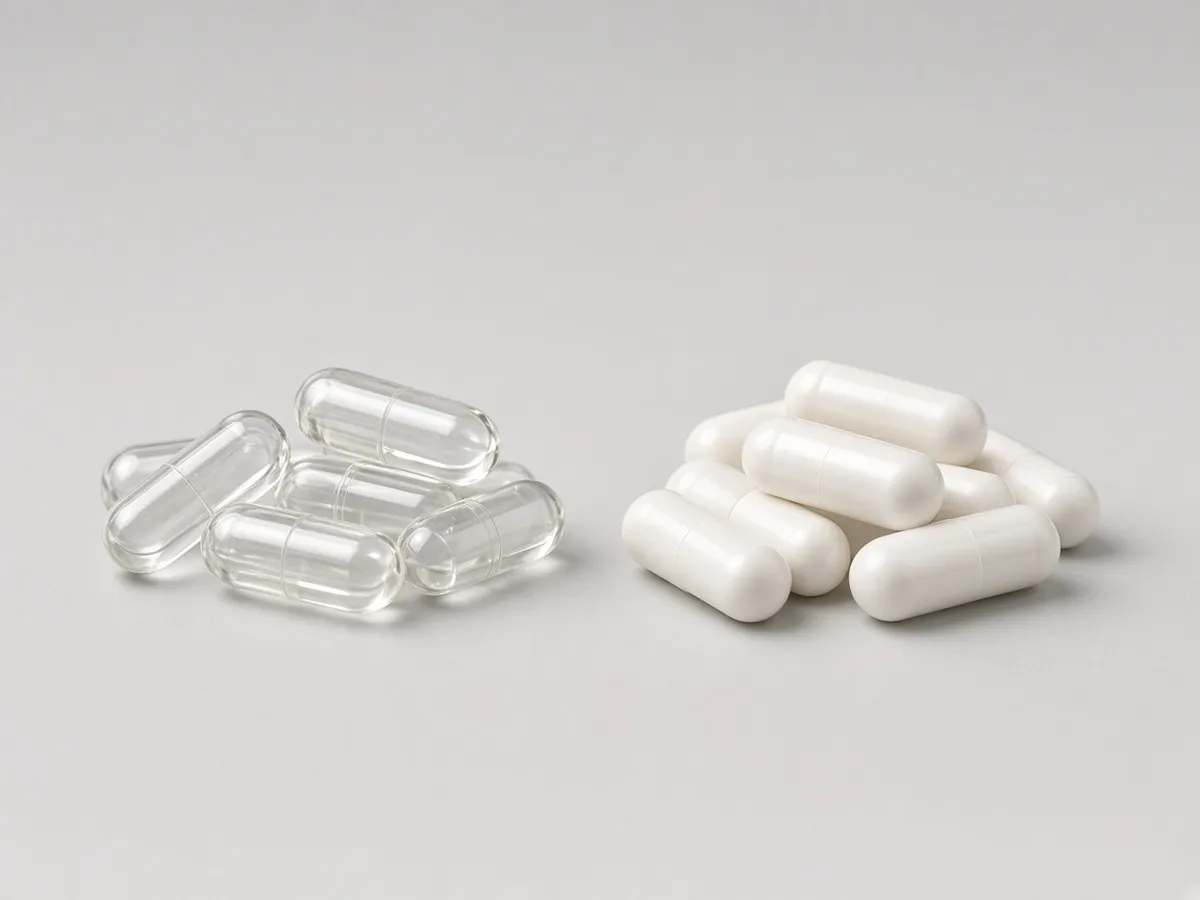
- Fill visibility. Clear shells show the powder. That suits attractive or uniform fills, such as bright botanical powders, and it is a visible “nothing to hide” signal. Dark, mottled or oxidising fills may look less appealing.
- Light protection. Titanium dioxide helps shield light-sensitive actives. If you remove it, check stability, and consider opaque packaging such as amber or white HDPE bottles or blister foil, or a coloured shell.
- Colour matching. Without a white base, pastel and bright colours can look different. If an existing SKU’s colour is part of your brand, request colour-matched samples through our custom colour capsules service and approve them before ordering in bulk.
- Labelling. Many brands now put “No titanium dioxide” on the label. Make sure your supplier’s documents support the claim (see the checklist below).
What does TiO2-free mean for shelf life and light protection?
Titanium dioxide does more than make a capsule white. EMA’s 2021 report to the Commission noted that no single material yet matches TiO2’s combination of opacity, inertness and protection from UV light. Possible alternatives include calcium carbonate, talc and starch, but each has drawbacks (EMA, 2021). The Commission’s 2025 review summarised EMA’s updated findings in three points (European Commission, 2025):
- Light: TiO2-free capsule systems “generally offer less protection against light”. That raises the degradation risk for light-sensitive (photolabile) ingredients and may call for more protective packaging.
- Opacity: alternatives often need a much higher percentage by weight to reach similar opacity, and the available colour palette is smaller.
- Performance: in vitro disintegration and dissolution of the current TiO2-free capsule shells showed no significant change compared with TiO2 versions, but their long-term stability is still being studied.
A published industrial case study shows why this matters. For a tablet containing a highly photosensitive drug, a calcium carbonate coating and a clear coating performed like the TiO2 coating under heat and humidity, but several degradation products appeared in large quantities under light when TiO2 was absent (European Journal of Pharmaceutical Sciences, 2024). That study was on a film-coated tablet rather than a capsule, but the light-protection principle is the same.
How brands handle it in practice:
- Check whether light matters at all. Many botanical powders, minerals and amino acids aren’t especially light-sensitive. Where the fill isn’t photolabile, a clear TiO2-free shell is usually a straightforward swap.
- Move the protection to the pack. Opaque or amber bottles, or foil blisters, can provide the light barrier the shell no longer gives. Confirm the effect with photostability data for your own product.
- Use an alternative opaque shell. Capsule makers such as Lonza Capsugel describe calcium carbonate-based shells that give a semi-opaque white appearance and some UV protection (Capsugel). Opacity, shade and light protection vary by supplier, so test samples against your current shell.
- Re-validate shelf life. Treat the shell change like any change to a primary component. Run stability on representative lots before you put the new shell into commercial supply.
How much powder fits in each capsule size?
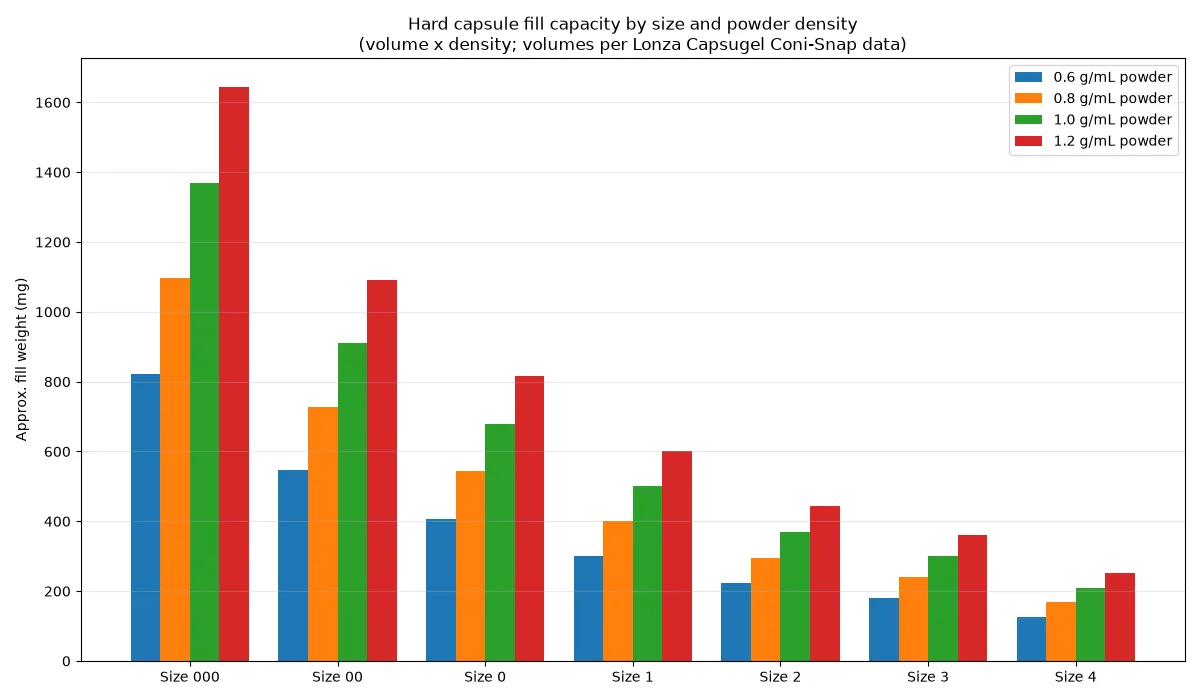
Going TiO2-free does not change capsule dimensions, so standard size data still applies. The fill weight is roughly the capsule volume multiplied by the bulk (tapped) density of your powder. The figures below are taken from Lonza’s published Capsugel Coni-Snap specifications (as reproduced in Tablets & Capsules, Nov 2020). Other manufacturers’ volumes differ slightly.
| Size | Volume (mL) | Empty weight (mg, gelatin) | Fill @ 0.6 g/mL | Fill @ 0.8 g/mL | Fill @ 1.0 g/mL | Fill @ 1.2 g/mL |
|---|---|---|---|---|---|---|
| 000 | 1.37 | 163 | 822 mg | 1,096 mg | 1,370 mg | 1,644 mg |
| 00 | 0.91 | 118 | 546 mg | 728 mg | 910 mg | 1,092 mg |
| 0 | 0.68 | 96 | 408 mg | 544 mg | 680 mg | 816 mg |
| 1 | 0.50 | 76 | 300 mg | 400 mg | 500 mg | 600 mg |
| 2 | 0.37 | 61 | 222 mg | 296 mg | 370 mg | 444 mg |
| 3 | 0.30 | 48 | 180 mg | 240 mg | 300 mg | 360 mg |
| 4 | 0.21 | 38 | 126 mg | 168 mg | 210 mg | 252 mg |
Need help picking a size? See how to choose capsule size and our deep dive on size 00 empty capsules in bulk.
Does removing TiO2 affect stability, storage or filling?
The shell polymer and its moisture behaviour don’t change, so your filling machine settings and storage practices carry over. Two things deserve attention:
- Photostability: if your active is light-sensitive, update stability data (see the light-protection section above).
- Visual inspection: clear shells make fill defects, dust and splits easier to spot. That is good for quality, but it may change your acceptable quality limits for cosmetic defects.
Storage rules are the same as for any hard capsule. Keep them in sealed cartons at controlled temperature and humidity. See storing and handling empty capsules in bulk.
How do you switch an existing SKU to TiO2-free capsules?
Most brands can move an existing product to a TiO2-free shell without reformulating the fill. A typical sequence looks like this:
- Audit your current shells. Ask your current supplier for the full shell composition of every item code you buy. Opaque white and most coloured shells are likely to contain TiO2 unless the supplier states otherwise.
- Choose the replacement look. Decide between clear, colour-without-TiO2, or an alternative opaque shell. Consider your brand, how the fill looks and whether it is light-sensitive.
- Get samples and run a filling trial. Check machine performance, separation and locking, fill-weight variation and appearance on your own equipment.
- Check stability. Do this especially for light- or moisture-sensitive actives, and when moving from opaque to clear.
- Update documents and labels. Revise your specification, supplier qualification file and, if you will claim “no titanium dioxide”, the label and marketing copy. Keep the supplier’s TiO2-free statement on file.
- Plan the cut-over. Align new shell lots with your packaging changes, and use up or segregate the old TiO2 stock for markets where it is still permitted.
Contract manufacturers that serve several brands often standardise on clear shells, or on a small set of TiO2-free colours, so one inventory works for both EU-bound and US-only orders.
Buyer’s checklist: what to ask a TiO2-free capsule supplier
- Written TiO2-free statement for the exact item code, size and colour, not just the product family.
- Certificate of Analysis (COA) for each lot, plus the specification sheet (dimensions, weight, moisture, disintegration).
- Full colourant composition, and confirmation that each colourant is permitted in your target markets (US 21 CFR Part 73/74, EU Regulation 1333/2008).
- Certifications relevant to your claims: Halal, Kosher, vegan, non-GMO, and GMP or ISO standards for the manufacturing site.
- Pharmacopoeial compliance (for example USP–NF or Ph. Eur. monographs for gelatin or hypromellose) if you supply pharma.
- Allergen, BSE/TSE (for gelatin) and residual solvent statements.
- Samples for colour approval and a filling trial on your own machine.
- MOQ, carton count per size, lead time, and price breaks by volume.
- Shelf life and storage conditions, plus packaging format (PE liner, carton dimensions, pallet configuration).
At Capsules Hub we supply gelatin (Halal certified, sizes 000–4), HPMC (000–4), enteric coated (00–3) and custom-colour capsules from Islandia, NY. Ask us about TiO2-free options in your preferred size and colour. Availability, MOQ, documents and lead times are confirmed in your quote.
Are TiO2-free capsules more expensive?
Pricing depends on material (HPMC generally costs more than gelatin), size, colour, certifications and order volume, much more than on whether TiO2 is present. Clear capsules are often the simplest TiO2-free specification. Custom colours without TiO2 may need extra development and colour approval. The reliable way to compare is to request like-for-like quotes for the same size, material and quantity.
Ready to switch to TiO2-free capsules?
Whether you are reformulating an EU-bound supplement, launching a clean-label line, or simply future-proofing against US regulatory change, we can help you specify the right shell. Send us your capsule size, material (gelatin or HPMC), colour, annual volume and target markets.
Request a bulk quote → or email sales@capsuleshub.us. Capsules Hub Inc., 85 Hoffman Lane, Unit W, Islandia, NY 11749.
Questions
Do empty capsules contain titanium dioxide?
Many opaque white and coloured hard capsules do, because titanium dioxide (E171) is the standard opacifier. Clear capsules contain none. Always ask your supplier for a written TiO2-free statement for the exact item code.
Is titanium dioxide in capsules safe?
The FDA still permits titanium dioxide in foods (up to 1% by weight) and in drugs, but EFSA concluded in 2021 that it can no longer be considered safe as a food additive because a genotoxicity concern could not be ruled out. As a result, the EU banned it in food supplements in 2022.
Are titanium dioxide free capsules required in the US?
No. There is no federal US ban. The FDA is reviewing a 2023 petition (CAP 3C0325) to revoke its use in food, and several states have proposed restrictions. Brands exporting to the EU must already use TiO2-free capsules for supplements.
What is used instead of titanium dioxide in capsules?
The simplest option is a clear shell with no opacifier. Coloured shells can use other permitted colourants without a white base, and some manufacturers offer alternative opacifying systems. Opacity and shade vary, so approve samples first.
Are clear capsules TiO2-free?
Yes. Clear (transparent) gelatin or HPMC capsules are made without an opacifier, so they contain no titanium dioxide. They are the most widely available TiO2-free specification.
Does removing titanium dioxide change capsule fill capacity?
No. Capsule dimensions and volume stay the same, so a size 0 shell still holds about 0.68 mL. Light protection may be reduced, so check stability for light-sensitive fills.
Sourcing empty capsules for your next production run? Tell us the type, size and quantity and we will reply with bulk pricing and availability.
Request a bulk quote Capsule size chart